Tuesday, 12 June 2012

Website Planning


As our website is part of marketing our film, I thought it was important that the style of the website reflects our animation style and so I have tried my best to do this. The link to our website is:
The homepage will consist of the film poster, along with the name of the production ‘Carpe Diem’. This page, like every other will have the links to the other pages and also the name of the production. In the left bottom hand corner, we will have symbols for twitter and facebook- these will not be working links as we will not have a twitter and facebook page, but this will fit in with our target audience. The colour scheme throughout the website will be green, black white and grey. There will also be myself and Kelly’s names at the bottom to show we created the website.
About
This page will be about our animation, with a brief synopsis. The background will be a key picture from the animation, possibly one from the beginning. We don’t want to have too much writing but enough to be able to tell what the story is about, instead enough for them to want to watch it and find out. This again will fit in with our target audience as they will not want to read an awful lot about the animation.
Crew
The next page will be about the crew and an explanation of what we had to do and how we all worked together. Pictures of us whilst shooting the animation will be included and this will also go towards evidence of what we have done. Links to each of our blogs will be on the page too, which shows the work we have produced and evidence too.
Inspirations
Our ‘inspirations’ page will explain and show pictures of all the places which helped us to develop our idea. From the independent animation that we got some of our inspiration from the style of, to Disney films such as UP and Tangled that we liked certain scenes of and the concept of the story- seeing as much of the world as they can. The other thing we liked about the Disney films is that they have a positive moral to their films and this is definitely something we feel would be a part of the message of our animation.
Locations
By locations, we mean all the different countries that Bill visits in the animation, explaining why we obviously (and unfortunately) couldn’t travel to the different destinations that Bill travels to. This page will also include pictures of the backgrounds from the animation that myself and Kelly created, which will give the page a bit more detail and will explain it more.
After I have created the website, the group will have to put together a focus group to get feedback from it and ways we can improve it. A write up of the feedback will be available to see on our blogs.

Monday, 11 June 2012

Task 4- Certification


Certification
My animation, like any film or television programme or publication, would have to be given a certificate. A certificate of these productions is constructed by the BBFC (British Board of Film Classification). They work on certifications of film, DVD and video games. There are six groups of classification, which I will be talking about in this essay.
‘U’ is the first and suitable for audiences aged four and over, although for productions aimed at children under four are still allowed to be watched. However, they are given consumer advice which states ‘Particularly suitable for pre-school children’. When films are given this classification, they do not include bad language, apart from ones not as bad if given a justification. They do not include any sexual innuendos, although kissing and cuddling is allowed. The only things that would fear the audience would be if a character is in danger with a positive and reassuring outcome. Another thing is that the films teach the audience positive morals and meanings, with a happy ending to each story. Most original Disney films such as Toy Story, Lady and the Tramp, Lion King etc are classified as a ‘U’. The BBFC doesn’t receive a lot of complaints, but in 2004, Shrek 2 received complaints after being classified as a ‘U’ but containing the word ‘bloody’.
‘PG’ is the next which stands for Parental Guidance. This in mind, anything shown on screen would not upset a child aged eight or over. When created, these films would not have been aimed towards a younger audience. Documentaries are a good example of these. Sex is obviously not allowed to be shown, but if spoken about it mustn’t contain detail, but on the same hand if a child would not understand the reference then it can be given a ‘PG’ certificate. Violence in the form of blood would only be acceptable. You wouldn’t be allowed to see how the injury happened if it involved violence and neither would there be dangerous behaviour that a child would be likely to copy.
‘12A’ and ‘12’ are both different certificates but both quite similar. ‘12A’ is for films that are not suitable for children under the age of twelve unless their parents views it with them and thinks otherwise. There may be strong language in it but not frequently and if it is said in a violent way then the film may be put into the ‘15’ category. Light sex references are acceptable, but not anything that wouldn’t be suitable for young teenagers and nudity may be seen but not in a sexual way. Violence will be seen but nothing to dwell on with a lot of detail with no emphasis on the injuries unless it’s a medical drama. Self harming, suicide of hanging may be seen but again, not anything to dwell on or with any detail showing that these actions are painful and not something for young teenagers to copy.
‘15’ films are not allowed to be seen in the cinema or bought or rented by anyone under the age of fifteen. Films classified with this age will contain strong violence, frequent strong language, portrayals of sexual activity, strong verbal references to sex, sexual nudity, short scenes of sexual violence or speech referring to sexual violence, discriminating language or behaviour and lastly drug taking. Even though drug taken can be seen in fifteens, the intake of substances highly accessible such as aerosols, solvents will not be shown.
The last classification is ‘18’. This means that nobody under the age of eighteen is allowed to view a film in the cinema or buy or rent it. None of the films classified with this age are suitable for children. It would contain very strong violence, frequent very strong language, strong portrayals of sexual activity, sexual violence, strong horror, blood and gore and discriminating language and behaviour. Drug taking cannot be promoted or seen as being encouraged but may be seen in some films.
Looking at all the different classifications, I think that my animation would be rated as either a ‘12’ or a ‘15’. There is only one scene in the animation that would affect this and that is when they are having sex, although you don’t see any nudity or anything ‘graphic’ just a duvet cover moving. This is something that I think would suit either a twelve or fifteen year old- but probably more fifteen. Other than that scene, our film could be rated a ‘U’. However, we did this scene purposely to bring the certification up and the target audience. We wanted to aim our animation at people that would be inspired by it, and not children.
Watershed is another restriction that can effect when things can be shown on the television. In the UK, Ofcom have regulated the time for certified films and programmes to be shown after 9pm. 18-rated content cannot be aired until after 10pm though, to allow for a gradual transition to ‘adult material’. The watershed time ends at 5am.
When producing our treatment for the animation, we said that we would want our work to be shown on BBC Three as their aim is to provide their audience with something different and we feel that our animation would provide them with that. It would probably have to be shown after the watershed, only because of the mild sexual reference, although it may be able to be shown just before it. 

Task 3- Laws of the animation sector


Legal and Ethical Considerations

There are many different laws and ethical considerations to be wary of when producing films, adverts, articles and television programmers. When creating my Final Major Project, an animation about a write of passage, there will be some laws that I will have to consider before showing the finished product publically.

The laws that can effect productions are:
  •   Social issues and sensitivities- Being delicate towards current social issues
  • ·         Representation of gender- Representing both genders equally and fairly
  • ·         Representation of religious beliefs-Fairly and factually representing religion and it’s beliefs.
  • ·         Linguistic usages-The translation of different languages
  • ·         Accessibility-Making your film accessible to the widest audience regardless of technology or ability.
  • ·         Professional body codes of practice- e.g. BBC producers guidelines
  • ·         Worldwide Web Consortium accessibility standards-Making web content accessible to the disabled.
  • ·         Broadcasting act 1990-Preventing ownership in tv and radio being in too few hands.
  • ·         Official secrets act 1989-Protecting official information.
  • ·         Obscene publications Act 1959-Restricting content that may be offensive to audiences.
  • ·         Films act 1985-
  • ·         Video Recordings Act 1984-Regulating the distribution of video recordings
  • ·         Race Relations Act 1976-To respect and not discriminate people of different racial groups.
  • ·         Human rights act 1998-Enable people to their rights and freedoms
  • ·         Licensing Act 2003-Not influencing the sale or use of alcohol, drugs or cigarettes.
  • ·         Privacy Law-Regulates collection of people’s personal information
  • ·         Copyright and intellectual property law-Protecting people’s work from being copied without permission.
  • ·         Libel law-Making a statement that may be shown to give a negative image to a business/group/indivudial etc (slander)


I have highlighted from the list laws that we will have to consider when producing our animation and making it available for the public to watch. I will be explaining why each of these could affect my work by using examples (with animations where possible).

The first is representation of gender, how both sexes are represented. In the story, there is a girl and a boy who grow up together, go travelling leading separate lives, find each other again and marry. Although I don’t think that this would have too much of an impact on our production, it could be seen that the woman and man are treated unequally. The man goes to university, where he gets an education and instead, the woman goes travelling the world, which the man also does after he finishes university.  

In the media, adverts are often banned for being sexist towards women, especially in the 1960’s, when woman were seen as housewives and of a much lower status than men. The picture on the right shows an advert for Volkswagen cars, with the car all smashed up. The writing at the bottom explains how cheap the parts are for their cars and says when your wife crashes your car ‘It may make you furious, but it won’t make you poor’.

Now showing an example of a cartoon, (http://www.youtube.com/watch?v=8aTjof5fqQo) this was first shown in the 1950’s, but replayed on Cartoon Network. It would have been a humorous cartoon at the time about different style cars and what they’re good for. In this era, women were constantly told they were bad drivers, and this reflects in the animation. Throughout the cartoon there are a few sexist comments, including having a moving garage so your wife can’t crash into it, women being bad at indicating signals and having a bra and cleavage decoration on the front of the car ‘revealing almost the entire fan’.
Nowadays, these comments wouldn’t be acceptable because of the Representation of Gender act, meaning that a gender cannot be shown to be lower than the other. As our animation has no talking, there definitely can’t be any verbal sexist comments (not that there would be). The thing that my group felt would possibly affect our animation with this law was as I said, showing the man being able to get an education and traveling and the woman goes travelling.


The next act that our animation may be in breach of if viewed by the public is Accessibility. This is when you must make your publication easy to access and obtain to the disabled or elderly. The reason why I think that our animation may not be easily accessible is because there is no speech, although there are a few sound effects and music to set the atmosphere and scene. Although I couldn’t find any examples of a breach of this law in the film or animation sectors, comparison websites have been under threat because they didn’t comply with the law. Organisers of the charity AbilityNet say that Confused.com Comparethemarket.com, Gocompare.com and Kelko.com are ignoring the basic guidelines and websites are not easily navigated for the disabled. "The law is clear on this issue. It is just as illegal to bar disabled visitors from accessing your goods and services online as it would be to keep them out of your shop in the 'real world' ", said Robin Christopherson, head of digital inclusion at AbilityNet, who is himself blind. [the Guardian].

The Race Relations act (1976) is another thing that I feel I should touch on with our animation. The reason being that one of our characters is black and one is white and in some scenes (such as at school and in exams) the other characters are multi-coloured such as orange, green, blue etc. We felt that these scenes may be perceived in the wrong way and seen to be racist. However, we wanted to make our characters different colours to the others to be able to distinguish them, and felt it would be easier this was as they have no voices. One Betty Boop episode was banned in the early 40’s/50’s from TV because it contained racial assumptions and stereotypes. The cartoon shows a baby contest from babies all around the world, and Betty Boop makes comments and judges throughout. There are three black babies which are introduced by Betty Boop as the ‘colourful three’. When you see them on screen, their appearance isn’t the same as any of the rest of the white characters, and their faces resemble those of the banned racist dolls ‘golliwogs’. The babies then start crying and are stopped by being given watermelon- another racial representation.

The last law we would have to take into consideration if we were to publically show our animation would be the copyright of the music. The copyright law protects:
·         Literary works- novels, song lyrics, articles etc
·         Dramatic works- dance and mime
·         Musical Works
·         Artistic Works- paintings, engravings, maps, logos etc
·         Layouts- typographical arrangements used to publish a book for example.
·         Recordings- sound and film
·         Broadcasts of a work.
The copyright law protects any work, and any work you create is automatically protected. With students producing work, as I am with my final major project, if something successful were to become of the work, college will own the copyright of my work and would be entitled to any money gained from it. If somebody dies, their work is no longer copyrighted after 50 years, unless somebody else buys or owns the copyright of their work. Having copyright of your work stops others legally being able to copy it or use it without your permission. If the fact that you have automatic copyright does not stop somebody from exploiting your material, then as the creator of the work, you have the right to take legal action.

Looking at all the different legal and ethical considerations that would apply to my film, I found it hard to be able to determine which ones would apply. The ones you automatically think of is showing alcohol and sex, but we show neither of these. Also, because we produced an animation with no speech or facial expressions or features, I think that it is harder to breech the laws. 

Case Study -Task 2


The Film Industry

Film and animation are the sectors that my Final Major Project will fall into. They both work a long side each other, seeing as my film is an animation. Both the sectors are quite similar, bearing in mind ownership and funding, thus why I will be talking about the film sector. It’s structure, distribution, ownership and impact on the market are all things which I will be covering.
The film industry is made up of two types of film companies, the major studios and the independents. The major studios are often known as the Hollywood blockbusters too. From this name, you can automatically tell that these films are likely to be pricey to make and well known. Some of the Hollywood studio distributors which are household names are Twentieth Century Fox, Walt Disney, Sony Pictures, Warner Brothers, Universal Studios and New Line Cinema. These companies are owned by their parenting companies, for example Fox is owned by New Corp. Their parenting companies are involved with lots of different forms of revenue and other interests in media. An example of this is that all of the well known film majors are owned by major television networks too (Fox and Fox Network), apart from Sony.
 Hollywood movies cost millions of pounds, take hundreds of hours with a huge cast and crew, lots of special effects and all for a few hours of audience entertainment. They use ‘top-notch’ technology and cast to make sure they gain their money back, plus more, they spent on marketing overseas, soundtrack rights and endless amounts of other aspects. Hollywood directors and actors are hugely known and people anticipate their next appearance. Their films are long lived and successful. These are the main difference between the major film industry and independent films.
On the other hand, independent films are created on a smaller budget. My film/animation for the FMP will fall under an independent film, as it hasn’t been made by the major companies. However, independent films will pair up with other film companies to enable them to gain their funding anand other areas of expertise. Independent films are thought to be distinguishable by their artistic styles, their unpredictable story lines, their characters, locations etc. This is a complete contrast to Hollywood films, as they are thought to be predictable with their ‘fairy tale endings’ and ‘boy meets girl’ situations. Independent films are often shot locally of nationally, and rarely afford to travel overseas due to their have a considerably low budget compared to Hollywood, who can afford to travel worldwide. They are often thought to have their five minutes of fame, with actors, directors and films that may only have a short period of time where they are widely known. This, however can reflect their budget again, not being able to cover costs of marketing worldwide and gaining the audiences they otherwise may have been able to.
A successful independent film is ‘This is England’, directed by Shane Meadows. The British drama is focused on the lives of young skinheads in 1983.Seven different companies produced it, including Film Four, the UK Film Council, Warp Films, Screen Yorkshire, Big Arty Productions and EM Media. The film became popular and so three years after it’s release, This is England ’86 was a new TV series that was produced, carrying on from the film and involving the same characters and gritty atmosphere.


Film 4 is not only a free movie channel on British freeview and television (owned by Channel 4), but also a film production company. They co-finance and develop British films and work with the most innovative talent in the UK. They fund around 20 films per year, most of them being first time screenwriters or directors.
The American film industry is dominated by film studios known as ‘The Big Six’. These are Warner Brothers, Paramount, 20th Century fox, Walt Disney, Columbia Pictures and Universal Pictures. The companies which own the Big Six are known as conglomerates. Conglomerates defines as “A number of different things or parts that are put or grouped together to form a whole but remain distinct entities” [Google Dictionary] .The companies are owned by the conglomerates as follows:
·         Walt Disney Pictures owned by The Walt Disney Company (worlds largest media conglomerate)
·         Universal Pictures owned by GE (second largest company in the world) and Comcast (Largest telecommunications company in the US)
·         Warner Brothers owned by Time Warner (Second largest Conglomerate)
·         20th Century Fox owned by News Corp (Third largest media conglomerate)
·         Paramount owned by Viacom (Fourth largest conglomerate)
·         Coblumbia Pictures owned by Sony Corporation (Fifth largest media conglomerate)
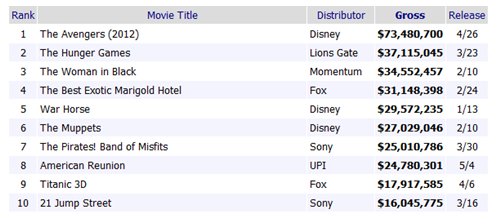
Britains film market is dominated by America with 75% of the total UK box office being American produced. Out of the top 20 successful films in the British box office, 18 of them were produced by the Big Six. Another example of this I found was from the website ‘boxofficemojo.com’. This is a screen shot from their website showing the top ten films and their distributors in 2012 so far. 

The chart shows that seven out of the top ten films were from a few of the Big Six, these being Disney, Fox and Sony.

The consolidation of the media ownership has it’s effects, one of them being that the small amount of Western conglomerates- mostly American, are taking over the global market. I think that this will eventually have a negative effect on the industry, as it will seem close to a ‘monopoly effect’, with few companies having most power over the industry, influencing the types of films coming from Hollywood.  
Looking at the structure and jobs in the film industry, ones highly involved in the creating of a film are as follows: screenwriting, feature film production, distribution and exhibition. Screenwriters are the people that think of idea for films, develop the idea to suit their target audience (as we have had to do in our FMP) and then write scripts from the idea. There are different assignments in screen writing. “pitched assignments” which are when a film project gets started by a script already written. These are often most successful. “Open” assignments are when film studios tell the scriptwriters what they want done, and this style is more competitive. Another way is for screenwriters to be approached to complete an assignment.
Production in film is the process of making the film from an initial idea to show what’s actually on screen with the final piece. A typical Hollywood-style film has the following stages of production: Development, pre-production, production, post production and distribution. These usually take about three years with development taking the first year, the second being preproduction and production and the third being distribution.
 Distribution is the next step to the structure of the film industry. Film distributers are people responsible for making the film seen to the public eye, either through cinemas, online or DVD, Blu-ray etc. It is arguably the most important part of the film industry, enabling audiences to connect to the films by the experience of the cinema or in the comforts of their own homes. In the UK, marketing is a big part of film distribution. In the independent film sector, they do not have long-term ties with distribution companies, marketing companies or a big list of helpful and reliable contacts like Hollywood would. In this sector, distribution can be divided into three stages: licensing, marketing and logistics. The logistics of distribution is to make agreements with the cinema on their ‘play-dates’. It’s important that they meet their deadlines of distributing and supplying cinemas with their film, as the cinema spends their money advertising and publicising their play-dates. When distributing, they handle 35mm film prints, costing around £1,000 each, unless subtitled which costs double. For easier handling reasons, the prints are split into 5 or 6 reels, each lasting 18-20 minutes. A flow chart below shows the distribution method of the prints.
  
Distribution of films is becoming easier, and it’s thought that van transportation of film tapes will soon be wiped out, with a lot of help from the vast developments of the internet. Digital screening costs around one tenth of a 35mm print. The UK Film Council and the Arts Council England created the digital screen network, in the hope to give UK audiences a much greater choice of films in cinemas. To do this, they equip over 200 cinemas in the UK the digital projection needed to give their audiences this wider choice and show them non-mainstream films. Some of these films include ‘Brighton Rock’, ‘My Week With Marilyn’ and the Oscar winner ‘In a Better World’. This organisation idea gave the equipment and necessities to independent cinemas who may have struggled otherwise to keep up with the well-known chain cinemas. Another way of digital distribution, which can have both positive and negative effects, is from websites such as YouTube. Lots of Disney films are known for having appearances on YouTube, although having being taken down a number of times, they keep cropping back up. This is something that would effect Disney, as people are able to view their films online, rather than going out and buying the DVD’s, Blu Rays etc. Pirate movie websites are also a threat, with the amount of websites offering free viewings of films dramatically increasing, I believe that the attitude towards buying DVD’s will worsen, and people will download and watch their films online much like they do with illegally downloading music. This will have the most impact on independent films, as they don’t have the money, backup and contacts that Hollywood does to be able to take legal action against these problems they may overcome.
Marketing is a strategy of distribution that the UK is renowned for. The most successful way of advertising new and up-coming films is to create a movie trailer. These are mostly played in cinemas before a film starts, which is the ideal way- your film being shown to ‘movie-goers’. It’s the producers chance to give the audience a taste of what the film has to offer and what to expect. However, film trailers can be difficult to get the right balance, as if too much information is given away, viewers will feel like they don’t have to watch the film. But, on the other hand, if not enough footage is shown it can be hard for the audience to understand what the movie is about. Films are also at great competition with each other, and poor marketing can make you lose your battle to the competition. A recent example of this is from the 2012 Disney film ‘John Carter’. The film was expecting to make a lot of profit from the box-office.  The person responsible for their marketing was MT Carney, an industry outsider who used to run a marketing boutique in New York. They rejected a lot of the ideas from the studio, including the look of the poster. The images used a put together to create the poster are thought to not appeal to the right audience and to perceive the right image that the film has. A quote from Stanton [found on Wikipedia] “My joy when I saw the first trailer for Star Wars is I saw a little bit of almost everything in the movie, and I had no idea how it connected, and I had to go see the movie. So the last thing I’m going to do is ruin that little kid’s experience.” Another aspect which made their film appeal to the wrong audience, even before it was released was the song used on the trailer by Led Zeppelin, called ‘Kashmir’. AS the song was recorded in 1974, they seemed to be appealing to the completely wrong audience. After watching the trailer, and a lot of other film trailers, I agree with the fact that the John Carter marketing sector appealed to the wrong audience. In films, music creates a lot of atmosphere and can tell a lot about the film, and using music from different eras gives the impression of the film being aimed at people living in that era. Because of their marketing screw up, and the fact that the film came out on the same weekend as Madagascar 3:Europe’s Most Wanted, they didn’t gain as much viewings as they would have hoped. To me, this comes as a surprise for Disney films, as they seem to constantly appeal to their right audience and gain the viewing figures they wish for.
It’s not just bad marketing that can have an impact on the sales of a film. In the eyes of films, you can never do too much marketing. The more marketing means more people know about your film, and the more money you are likely to make- if the right image of the film is given. The Blair Witch Project (1999) is a great well known example of good marketing. A lot of films benefit from social networks and YouTube nowadays, with word of mouth able to spread easily and the films buying space for adverts. Paranormal Activity (2009) has mostly Twitter to thank for their $193 million gross profit, from their film which was made with only $15,000. They encouraged people to write 140 character reviews for their film. The Blair Witch Project didn’t have this advantage, but they still managed to spread the news about their film from word of mouth. A term known for this is ‘viral marketing’, which defines as ‘A method of product promotion that relies on getting customers to market an idea, product, or service on their own by telling their friends about it’ [Google dictionary]. The film managed to convince their audience that the film was actual ‘found footage’. After researching the methods used for marketing the Blair Witch Project, the first thing I found was that they focused their strategy on wanting to entertain their audience, rather than selling it to their audience. This is known as ‘unmarketing’, because they focused solely on the story of the film rather than promoting the directors/actors etc. They went out to find their target audience instead of waiting for their audience to hear about them. They reached out to fans on online message boards to start with, and as they started to gain money from the film, they reached out via the Sci-Fi Channel. As they had a low budget for their film, they didn’t start to advertise mainstream until they had money to do so, and especially until they thought that their target audience was excited for the film, and so they pretty much knew they would get the money back. They took common fears, of the dark and the woods, of ghosts and witches and made the audience scared, but wanting more as the whole of the story was never actually told. Even before the film, they set up a website to keep the audience attached to wanting to see it.
After producing this case study, it has fed me with information about the different film sectors, their distribution, marketing and structure. It’s clear how important marketing can be to a film, how important the jobs of screen writers are and also distributors. From what I have learnt, it will encourage me and enable me to understand the process in making my Final Major Project if it were to industry standard both in Hollywood and Independent level. 

Thursday, 7 June 2012

Task 1-Sectors of the Media

The Umbrella of Media
The main aim of the media is to communicate with it's audience through informing, educating and entertaining. It can communicate with it's audience in a number of different ways and platforms, these are known as different sectors of the media. The different sectors of the media I will be looking at are:
  • Film
  • Radio
  • TV
  • Publishing
    • Newspapers
    • Magazines
    • Books (e-books)
  • Internet
The film industry is made up of Independent films and Major Studios. Independent film companies are those that are involved and engaged in the process of producing and distributing films. They fund their films on a low budget, use actors that aren't widely known and have story lines that are quite ‘out of the ordinary’. A lot of funding in the UK for independent film makers comes from the Arts Council. They are a charity who give funding and grants to people they feel are worthy who want to create productions of a kind of art, whether it’s dancing, reading, music or digital film, as it would be in this case. Film 4 is not only a TV channel but it’s also a film production company called ‘Film 4 Productions’. They develop and co-finance films with a distinctive and creative flair- Slum dog Millionaire, for example. Independent films make most of their appearances in film festivals, such as Cannes Film Festival. For our final major project, my group is making an animation; this is a part of independent filming.
The Major Studios, otherwise known as Hollywood Blockbusters are worldwide known companies such as Walt Disney Co, Warner Brothers, Sony Pictures, and Paramount etc. They receive their funding for their films through a countless amount of ways, such as current revenues, credit facilities with banks, public and private offerings and advance payments. Hollywood films cost millions and billions of dollars to make, a very steep price compared to independent filmmakers. This can make it a lot easier in some senses for them to gain their finance, from profit they have made in previous films, and pitching to people with enough experience and knowledge in Hollywood films to know they will be a success.
The chart below shows the structure of the film industry, mainly in America. The top row of the chart shows the ‘parent’ companies. These are the companies at the top of the chain who own and have power over the ones below and who create the films. These are Walt Disney, VUE, Sony, Viacom, News Corp, Time Warner and Liberty Media. The next line in grey, is the major studio distributors. These are people who distribute the films to other major companies. Some of these studio distributors are Disney/Miramax, Paramount and Twentieth Century Fox. Using a section of company from the flow chart as an example, Time Warner is distributed by Warner Bros. Dream Works is a distributor, but isn’t a part of another company like the others are. The next flow of the chart in brown, is the major studio speciality divisions. These are the people that acquire rights t the studio’s picture and deal with marketing and finance. Twentieth Century Fox’s specialty divisions are Fox Searchlight. Next they have the Broadcasters, the people that are allowed to show the films, who are Fox in this case. Next are the cable broadcasters, who are the cable TV channels who are part of the whole chain of the company. Fox’s cable networks are FX Network and Fox News. Next are the Cable/ Satellite Systems who are the satellite systems that broadcasts the channels. Fox’s is Comcast Continental. Lastly is the retailing, which is the shops and shopping 


channels part of the company, in this case QVC.


 Radio is another part of the media sector. It is a distribution of audio content, where presenters generically play music, discuss topics and conversations and tell the news sport and weather. Radio falls into three categories, publicly funded radio, commercial radio and community and voluntary radio. The industry employs over 20,000 people, more than terrestrial TV, which is a type of television broadcasting that doesn’t require satellite transmission or cables.
Public broadcasting radio is provided and funded by the Government, who receives money from taxpayers and TV license payers. BBC is a public broadcaster, with not only radio but television as well. Because the Government funds the BBC, they have an advantage of not having commercials and adverts throughout their shows.

The chart above from Ofcom shows the amount of money from the public for license fee’s Worldwide, and how much of the money was used towards radio. In the UK, with only just under 4% of it’s total advertising expenditure coming from radio, over 60% of the public fee funding was used.
Commercial radio stations earn the majority of their money from advert spots that they sell to businesses or service providers or mentioning them on air. Commercial radio is often local radio, such as Heart FM but it’s also national radio, like Kiss FM. To buy radio airtime, they measure it on ‘cost per thousand.’ This means that for every thousand people that the advert impacts. Each station has an individual price for how much they charge, depending on the size and scale of their radio station.
Community radio is stations that are ran by hospitals, students and small towns. They have to apply for radio licenses and some only apply for Restricted Service Licenses. RSL’s are short term licenses with a duration of up to 28 days. Volunteers often run them and they cover approximately three kilometres, enough to cover the radius of a town or city.
Publishing covers magazines, newspapers and books. The act of publishing is to make information available to the general public. Before films, television programmes and radio, it was known for publishing books, magazines and newspapers. In this instance, I will be talking about print publishing.
Magazines have been published for over three hundred years. They cover topics such as art, music, film, fashion, food, lifestyles, travel etc. Niche magazines is a term used for magazines that appeal to only a certain, smaller audience These would be magazines based on fishing, gardening, hair, food, for example. Life style magazines and ‘gossip’ magazines are ones that are highly read, especially by women. The National Readership Survey is an example of a company that works along-side the industry. It estimates the circulation of magazines and the demographics and social groupings of people that read them from their readership surveys. From these results, the magazine can be helped to target their magazines to their circulation ages and demographic groups. 

Newspapers are scheduled publications containing news. They are printed on low cost paper, known as ‘newsprint’. Newspapers fall into two catergories, a broadsheet and a tabloid. Broadsheets newspapers are seen as the more informative ones, with news about politics, the economy and covering also overseas news. The size of them is typically double that of a tabloid. Broadsheet newspapers include The Guardian, The Independent, The Daily Telegraph and The Observer. Tabloid newspapers are ones such as The Sun, The Daily Mail and The Mirror. These take into consideration more news about celebrities, lifestyle and human interest stories. Rupert Murdock is the owner of The News of the World, The Sun and The Times, as well as owning 39% of the UK’s satellite broadcasting. He has been talked about a lot in the news recently for his ‘phone hacking scandals’. He and his newspaper companies have hacked into people’s phones who have been covered in the news to find, or add on to, news stories about them- for example, Milly Dowler, a thirteen-year-old girl who was abducted. Another thing that Rupert Murdoch is known for is for what looks like attempting to cause a ‘monopoly effect’. This is when a company or person owns all of the news and media, consequently having control over what the viewers can read and see in terms of news etc. This is something which is illegal in the UK, as you wouldn’t be able to see the full sides of news stories, and the company can pick and choose what it’s audience and what the country knows about.

It seems that since the recession, the internet has had a big impact on all the different parts of the media industry. Publications are now able to be seen online. Newspapers publish their articles and many more to their online sites, as do magazines. There are now apps on smart phones where you can access news and purchase electronic copies of magazines for your iPhone or iPad etc. E-books are now available too, which are electronic copies of books for kindles and iPads etc.  The internet is a broad platform where people can upload their own films, tv programmes, podcasts, music, articles, photographs and many more. Even uploading essays onto blogs, as I am now. These can all be both positive and negative things. Positive, because people’s work can have more of a chance getting noticed through websites such as Youtube, but also negative because the creators voice is lost, with no control over where their work goes, who sees the work or who may unknowingly copy their work. Although I definitely see it as a good thing to be able to have a fountain of news, magazines, music, films, television programmes and whatever else at your fingertips, this amount of accessibility is always going to cause problems somewhere. For example, in China they blocked the search engine Google because they wanted to “ keep strict controls on the flow of information to its own citizens.[BBC News]

The ‘Umbrella of Media’ is the different sectors in the media industry which I have covered, as well as their importance to the industry and an overview of which each other sectors does, as well as the sectors within themselves. 

Monday, 28 May 2012

M&M's SWOT Analysis


SWOT Analysis of M&M’s
SWOT stands for strengths, weaknesses, opportunities and threats. It’s a simple, yet effective way of evaluating an organisations which not only makes sure you aware of your current surroundings but also helps you shape how you want your business or organisation to be.
M&M’s are hard shell coated chocolates that are highly recognisable and know worldwide. They are owned by The Mars Company and date back to 1948.
Strengths
·         Worldwide reputation, meaning the world recognises them and trusts the brand.
·         Part of The Mars Company, giving them back-up from other chocolates they make such as Galaxy.
·         Their marketing and advertising image is individual with sweets as characters.
·         Affordable chocolate that pretty much anyone can afford, making the sweets easily accessible.
·         Lots of varieties of colours, appealing to a lot of people and any occasion.
·         Personalisation of M&M’s, making gift ideas and for weddings, birthdays etc.

Weaknesses
·         Although M&M’s are the number one chocolate sellers, their adverts and marketing take cost a lot of money in comparison to other Mars products.

Oppurtunities
·         Having a worldwide market means that any new product they undertake will be instantly warmed to.
·         The M&M shops worldwide are not only shops but tourist attractions, increasing sales all the time and ultimately widening their consumer market which will be ready for any new products.
·         They have over 30 licences to create other products such as t-shirts, mugs, soft toys and figurines.
·         Advancements in technology- building up on their characters, developing more products.

Threats
·         Lots of competition everywhere from other confectionary and chocolate makers.
·         Their main competitors ‘Hershey’s’ are always creating new chocolate bars.
·         Increase and inflation of making chocolate could grow, making the chocolate more expensive, thus losing customers from their reasonable pricing.


Evidently, M&M’s are a huge company who must have gone through some SWOT analysis’ in their experience of building up their business. Weaknesses of them is something which I struggled on, as obviously they can’t have too many weaknesses as they wouldn’t be the great success that they are. The major threat to them, like any company, is their competition. Making sure that they come above bigger and better than their competition is something which businesses thrive upon. Finding customers that would rather go to their company than their competitors is vitally important. Their advertising strategy of using their sweets turned into characters is something that I have picked up on a lot, and something which I believe makes them stand out from the rest of the chocolate and confectionary world. Although it costs an awful lot more money than other chocolates in the Mars Company, which I have stated as a weakness, it’s an idea that has definitely worked in getting them recognition.